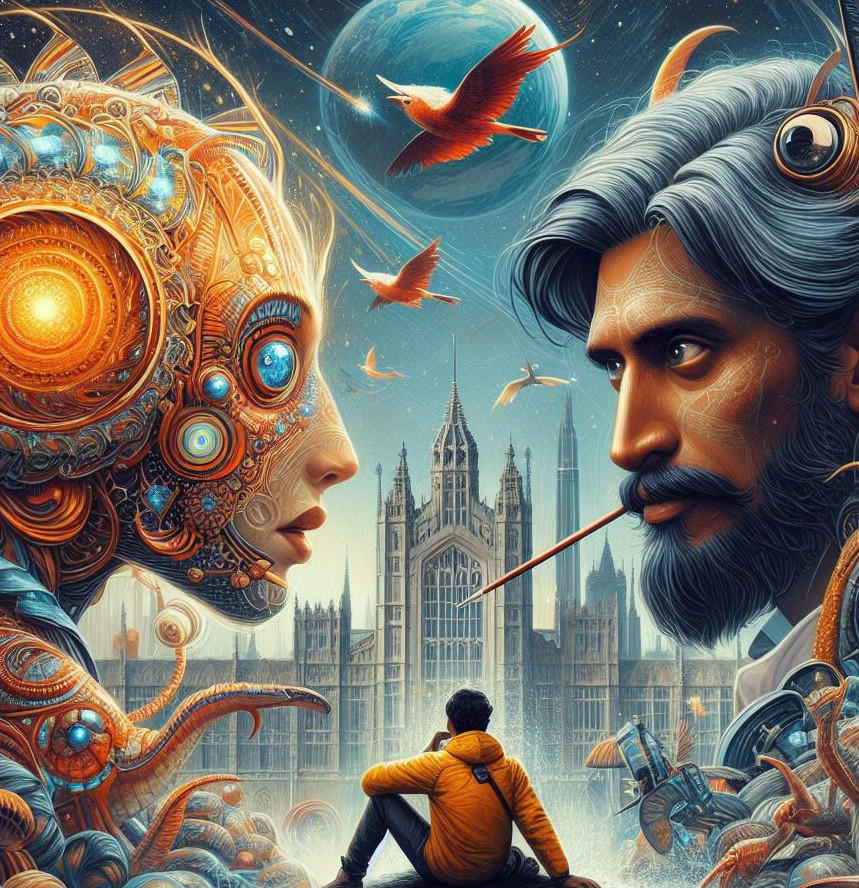
The eldest son sits hand resting on the tiller.
He is alone.
And today that is okay.
The sky is bright and the breeze is warm. Clouds lay scattered across the blue.
He sees a jagged line of darkness separating the sky from the shifting grey green waves. It is a familiar coastline, rising slowly out of the sea like memory. A story, oft remembered, of when the eldest son walked this shoreline with his father. Long, long ago, or so it seems – in his middle age the eldest son knows that time, more often than not, is a bastard. He sails on.
He returns here often. He has recalled and replayed this memory so many times now that what was once a thorn has become a soothing balm. As he has aged this memory has changed. He understands, or so he hopes, what this moment means. The eldest son regards this as the best day, the truest day and yet also, one of the worst days. This is the closest he ever got to knowing the man behind his father. Yet, as wonderful as that thought was when it first struck him some years ago, he knows that time is not only a bastard but also a trickster and a thief. Some details remain, others have faded or been replaced. Read a story as a child and you delight in the hero and the adventure and the victory. Reread that story as years later and you see the hardship and the struggle and the pain.
But in among those shifting details there are fixed points. Buoys that the son has laid down in past encounters. A stone, a smile, a hidden knot. These are the moments that, the son hopes, retain their position and their truth. Moments he understands to have actually happened. It has been a little over seventeen years since this day on the beach with his father. The eldest son hopes that the buoys will still be where he left them. So that way he will be able to navigate this retelling of the memory story.
In truth he does not know why he returns here. The relationship between father and son was never easy. In some ways it would be better to let the tides take it all away but there is something here that the son needs. There is the familiarity of course. And a kind of joy in trying to hear the South London cadence in his father’s voice and to see that lopsided smile one more time. He won’t ever admit it but the eldest son has attached himself to this memory. He anchors here because he sees something attractive, something worth seeing, something worth being near. This moment has eased the son slowly, purposefully into the rest of his life. As he gets older the son will lose many memories of his father but never this one.
Today, however, offers up a new perspective, different from his previous journeys along this shore line. He steadies the boat as it rocks on the incoming tide knowing that the granular close ups of the first few instances, he sailed these waters have gone. Along with the stark colours and the hard edges, the difficult words and his wrenching inability to respond. Indeed, as he gets closer, new details are revealed: a sea bird’s shrillness; tufts of grass that look like a row of puppets; the smell of salt and decay.
Is there a new quality to the light that was not there before? What is this change?
The eldest son bows his head. He feels an answer creeping along his spine: familiar tentacles now cradle the boat. They slither along the old wood and curl around his feet. A thing from the depth of the ocean and his memory. This part is as hard as it was the first time he sailed here. Back then the eldest son did not know what he was doing, did not understand what was being replayed for him. He could only feel the agony of remembering and the salty tendrils pulling him into the dark water. Once again, the lithe limbs twist and grip and squeeze and slowly the pain crushes his chest. Even though he has felt this cold embrace many times now, he is still shocked when all the air leaves his lungs.
The January sky is clear and sharp and cold. The previous day’s storms have blown through leaving turbulent eddies in the air and waves crashing about the ragged headland. A restlessness that seems to have nowhere to go except up and down the damaged coastline.
The father, two of his sons and two of his granddaughters set off down the narrow path, away from the cottage that the father and mother have been renting till they can move into their “forever” home. This cottage is a damp blister of a building, a sad excuse for a dwelling that overlooks the rolling expanse of the North Sea. The younger son and his children are bringing up the rear. The eldest son and the father forge ahead. The mother remains in the cottage: she has walked this path with her husband already.
Five minutes in and the youngest granddaughter throws a tantrum, no more walking, she has walked far enough for today and this is cold and wet and boring. The younger son is forced to attend to his daughter and reluctantly turn back. Father and eldest son look at each other. With an unfamiliar nod they decide to carry on. Just for a while. Not too far, all things considered. The father waves to the younger son, shouting against the wind that they won’t be too long, to tell Mum to put the kettle on.
Today the father wants to talk to his eldest, this is unusual but he knows that is necessary. He does not understand it fully but the eldest boy feels as if he is there to listen, even if he does not really want to. As they walk farther from the cottage the wind blows in strong off the sea. It is hard like ice but the sun on their backs is surprisingly and pleasantly warm.
As they step off the path onto the windblown beach father and son meet the first set of groynes. Massive slatted walls, wet structures sloping up from the dull sand into the cloudless sky. The father and the eldest son are on the leeward side of the battered framework. The son says that they look old, about to fall apart. The father replies, that they had been put up only two years before. The son squints at his father, doubt and disbelief on his lips. The eldest son does not disagree today. The air here is still and wet among these slatted shadows. Quiet save for the drip, drip drop of water trying to return to its source. Barnacles watch warily as father and son walk pass them.
Stepping out from behind the salt-stained structure the wind slaps the old man and his son hard in the face. The son looks up into the seemingly limitless sky. He sees time and space and possibility. The father stops a moment and stares down the beach. He is preparing. He glances at his son and feels nervous because he must be delicate and strong and to the point. A combination that is alien to him. But everything since that talk in the doctor’s office has been alien to him. The father points to the next set of groynes and leads the way.
“It was a fuckin’ massive storm Jay,” the father informs his son with a little too much glee. “Bloody brilliant, I’ve never seen anything like it.”
His foot slides in the sand and the father catches his side. His face creases and, just for a moment, the old man’s eyes water. It could be the wind. The son says nothing, pretending not to notice, scared about what this reveals but, it is not his turn to talk. The old man nods and they keep walking.
“Your mum and me watched it roll in from all the way from out there,” he points at the horizon and grins. “At first it seemed really far off. Moving slowly, majestic, like a procession from a Charlton Heston film, taking its own sweet time. Then – boom – all of a sudden it was right on top of us. Biblical clouds, booming thunder and rain lashing the windows so ‘ard you couldn’t see out properly. The roof was rattling above our heads. Fuckin’ marvellous!”
The son knows that his Mum’s version of the story would be very different.
“There, see,” the father points at the wall of wood. The son feels small again, out on an adventure with his Dad. “Imagine the strength to do that.”
They are in front of the next set of groynes. The son’s eyes follow the line indicated by his father’s finger. At the top of the groyne there is a torso sized stone that the storm had forced into the dark wooden slats. Splinters of pale untarnished wood halo the glistening rock.
“That’s huge,” the son cannot take his eyes off the stone.
The father pats his boy’s shoulder and carries on. The son follows. As they walk, they talk about the forces of nature, the futility of the local sea defences, how the cottage the father and mother have been renting would be gone in a year or so, which was why it was so cheap and rundown. Temporary in every sense.
When he looks back at this moment in the years to come the eldest son will not know how they managed it. All this easy chatter, this idle talk about stuff and nonsense. The closeness, the ease of it. It was not something that came easily to them, father and eldest son. Usually, things got in the way. Usually, they let things get in the way. Their tidal defences had been built and maintained for years now.
Yet, here they both are on this sunny and turbulent late January day. The wind scouring their faces, the sun soothing their necks as they walk. In this moment it does feel easy. It feels good. Neither of them realises that, in the few months that they have left, they will not be able to replicate this moment.
Cliffs loom in front of them, the headland is blocking their path. Father and son look up. Half a bungalow balances on the freshly ragged edge. The son points to what used to be the bathroom, judging by the remaining tiles and the dangling shower head. The rest of the building lays strewn down the raw cliff ending in a shattered heap at the base. Plaster board and net curtains in a wet tangle. Torn carpet. A sink. Splintered skirting boards reach up into the air like bony fingers.
“Lost in the storms between Christmas and New year,” the father says. “One day up there. Next day… The family are okay, they moved out in September.”
Something catches inside, a knot tightens and pulls. Not that long ago a specialist identified the thing, the exact spot where it lay. X marked. This dark, little knot confused the tides like a second moon in the sky. They flowed backwards and sideways, over and under him. The knot gave way to uncertainty and questions and a sense of so, what now then? The father looks at the shattered house and thinks it is nearly time. He looks at his son, his eldest, eyes bright and questioning, always drinking in details, always noticing odd things. The one with whom the old man has struggled with the most, the one with whom he is perhaps the proudest.
“Should we turn back?” the eldest son is suddenly conscious that his father looks pale and tired. It is getting late, it’s getting colder.
“Yeah, it’s a shame, but we probably should,” the older man turns to face the other direction, back toward the temporary residence.
They are slower on the way back. Accommodating the little black knot that was growing in the father’s bladder. The cancer. He’d had the symptoms for months. Not told anyone. Had not even told his wife, the retired nurse: they were moving house, no sense worrying her about old man troubles. No fuss needed to be made. He hadn’t said a word till the pain had become too difficult to hide.
As they walk back, the son watches his father, out of the corner of his eye. Hoping his father doesn’t notice these furtive glances or sense the feverish worry. If he notices, the father does not say anything. There is a deliberateness and a caution in the older man’s step, a wariness where before there had always been confidence. Looking back, the son will realise that this day was the first time that he noticed his father was starting to diminish.
They stop by the groyne with the stone and the splintered halo.
“Does it hurt?”
“Yeah, a bit. Just need to get my breath back,” the father leans on the grey wood.
“No worries, loads of time,” the son watches his father’s chest labour in its rise and fall. The son closes his eyes and when he opens them again, he is looking out to sea. The horizon is so very far away, but he sees lines of gold and orange, a shimmer of light dances on the wave tops.
The older man looks out across the waves. A shape bobs on the water, a boat in the distance, some fool out on the unforgiving sea. In weather like this? Idiot. But sailing off to wherever they fancy. Yarmouth or Timbuktu or tomorrow. The older man would like to feel that some more, to feel the possible he sees in his son’s face. That is a freedom he does not have today. The waves roll in, churning and crashing and reminding him that time is not his friend today.
The sky rises up and over father and son, crisp and clear, dwarfing them both. As the sun starts to set, they are seen here in isolation. Not another soul on the beach this January afternoon.
The wind dies down a little.
“If it wants to take me, I’ll let it,” the father’s breathing is more even now.
“What?”
“This,” he pats his still rounded belly then smiles at his son. “Oh don’t worry, I’ll do what the doctors and ya’ Mum says but, if it looks like the cancer’s gonna win – well, the cancer’s gonna win.”
“Don’t,” the son looks his father straight in the eye, for the first time in a long, long time.
“Listen, Jay, if it’s my time to go, I am going to go…”
“Wait, you’re only sixty-three…”
“It’s my decision. I’ve talked to ya’ Mum…”
“You have a lot to live for…”
“Yes, I know. But…”
“You can live a good life; you should be planning for…”
“Jason,” there is a firmness in this voice. It feels odd, it feels familiar and strangely kind. The son has no choice but to listen. “I’m okay mate.”
The son stares at his father.
“If this is my time then I am happy to go. I don’t want the pain, for me, for you, for Mum, any of us. I just don’t. And it’s my decision,” the father’s eyes look old and wise and more than a little scared. “I’ll be alright with it. I will because I know that you, your brothers, their kids, your Mum, you, you’ll all be alright. If I am not here, you will all be alright.”
The son blinks.
An ocean rises up in front of him. Wide and dark. Tempest driven fury. White capped waves ride in a hundred feet high, fuelled by the son’s selfishness. He feels so small in this moment. Small and mean and angry. He should offer something to this man in front of him. Something comforting and real, some words of reassurance. Maybe even a hug. None of that seems possible.
This man is his dad. As imperfect as he is, as imperfect as they are to each other, the eldest son knows that he still needs the old man. That Dad that handed out presents each Christmas morning, pulling them from under the tinsel heavy tree, who became the lump in the armchair closest to the fire, cracker hat askew, snoring his way through the Queen’s speech.
The dad that took them on late summer cycle rides to the woods, picking blackberries – remember now, leave the high ones for the birds, don’t touch the dog-piss ones down there. No sweets in the back of the car, even on long journeys. Driving through the night, windows down to keep Dad awake. Mum with the map and instructions on her lap to take them all to the ferry.
Radio One in the living room on the big speakers, don’t touch the dials. Another game of monopoly, Dad the banker and the rule maker. HP sauce on everything even the Sunday roast. Fry ups on a Saturday watching Dusty Bin. Thunderbirds and Doctor Who, Blakes Seven and Star Trek. The father’s motorbike phase, the pipe smoking phase, the judo phase, the snooker phase, the golfing phase. Taking a joke a step too far and loving it.
Missing his eldest son’s wedding because, well two men? The eldest son’s not a phase that never sat right with the father and was never to be discussed. The gruff voice on the end of the phone, the certainty of the man. Wanting to build a bridge but not knowing where to lay the first brick.
Instead, they built a generational sea wall between father and son.
There are questions that need to be asked, arguments to be had, resolutions to fight for. The son needs so much more and suddenly there might not be time? Something dark slides across the bottom of this new ocean. A tentacle wrapped thing that stirs a little and looks up at the son. It shifts beneath the tempest tide, reaching out across the sea bed. It senses the angry pulse of the younger man and moves closer.
“Okay,” the eldest son says.
And somewhere between his ribs and his lungs a hole opens up scalpel slowly. Precise and cold, the howl in waiting. In the depths the tentacles stir. The son looks up at the stone with its splintered halo, then the sky, then the waves and finally at his father’s tired face. The eldest son smiles awkwardly. The father nods and stands up. The two men continue back to the cottage. Step by slow step. The wind picks up. They talk some more on the way back up the beach but from now on the son will not remember what was said. The rest of the day becomes a watery blur. There is the fading sunlight, the wind and the hole in his chest. When they get back to the cottage, Mum greets them with a sad smile and puts the kettle on. The tide rushes in.
Be First to Comment