Last updated on June 29, 2026
14 October
Sayer says I should keep a journal. It isn’t for them, you’ll understand, she was clear about that; the official record is kept elsewhere, in somebody else’s hand. It’s for me. A record of my feelings about the work I’m doing. She says it will ground me in reality and give me an outlet for my frustrations. The way she said it made me think there will be many. In her normal, laconic manner, her suggestion took on the air of an imperative, rather than a recommendation.
“You should write a diary,” she said in that curious, eastern accent of hers. “It will be good for you.”
So, I bought a heavy, leather-bound, A5 notebook, which looks rather like those Filofaxes that were popular before PDAs swept them away, and here I am at the kitchen table at an unreasonable hour, writing the first honest sentences I’ve managed in a year.
So, the facts. Since I spent thirty-one years telling students to start with the facts, I will do so too.
My name. I am Philip Alcibiades Struthers, and I am the second Professor Struthers in the family. My father, as you may have guessed, was a classicist, but his ambitions for me in naming me after the great orator and charismatic general of the Peloponnesian War were not realised.
I am retired, but I used to study the points in history where the human race could have leapt forward and didn’t. These I called breakpoints, which was a bit of a reach, but the idea is simple. Every so often, we get within arm’s reach of something that could change everything, and then we drop it, or burn it, or forget it, and the world goes quiet for a few hundred years as if it had never happened at all. I gave a lecture about it for most of my career. Lord knows why, it wasn’t very impressive, just a shopping list of what-ifs. I refrained from connecting the dots because that wasn’t a territory in which academia dwelt comfortably. Instead, I left the theme as ‘missed opportunities’. Most of my audience wanted more than that damp squib. I demurred to make more of it than light scrapings of an archaeologist’s trowel revealed. My audience came expecting something insightful and left looking like they’d watched a summer news item on a particularly slow week. I was July hailstones in East Anglia, both unexpected and gone before anyone cared.
Sayer came to the last lecture, but she didn’t look bored. Noticeably so. At least to me, anyway. Afterwards, she asked whether it had ever struck me that the losses I listed were too tidy to be bad luck. I said yes, I had. Not in my daily life, and nothing I would commit to paper. But I thought about it at three in the morning, when I sat in my armchair, trying to cool off my overheated limbs, and my mind would wander to the possibilities of a guiding hand. Of course, I would tell myself off for such asinine thoughts. I was, after all, a serious academic, albeit one with an admittedly fading standing. Then I would slap my legs, mutter the obligatory “right”, and determine that I would get on with my latest paper, the one that had been sitting in my drawer for twenty years and forget about such frippery.
That’s when she dropped her hammer blow. She said that she ran an organisation that took the silly thoughts I’d been having seriously. They kept files, and she’d like to show me what was in them.
I should have said no. Indeed, I keep looking for the moment I could have said no, and I can’t find it. There was no door I walked through. It was just a long, slow ramp, and every step of it felt inevitable. Just like my breakpoints.
21 October
I can’t tell you what’s in the files, except inasmuch as such knowledge, as it always does, comes with a price. Mostly, I can’t tell you because I’m not allowed, because you would need to be indoctrinated. That’s their word, not mine. But also, partly because writing it down in unadorned words turns out to be the closest thing to the very act I’m supposed to be making up my mind about, and I’m not ready to do that, least of all in a notebook. Not yet, anyway.
But I’ll say this much. Every history I ever taught had holes in it: a burnt edge, a guess, or a “we don’t really know why.”
The files don’t have holes. They have the name of the man who struck the match and the order he was following. Moreover, they have the name of whoever wrote the order. They go back further than anything I have ever seen, and they don’t seem to have a beginning or, for that matter, any edges. Everything is cross-referenced to the nth degree. As a primary source, an on-the-scene witness account, they are utterly peerless. Since I started studying them, I have barely made a dent in the surface. I could spend a lifetime just reading these magnificent accounts. Sadly, it is a lifetime I don’t have, so I’ve devoted myself to exploring a small part, one that coincides with my own particular interests.
The one I keep coming back to is the palimpsest. Most people have never heard of it, and I won’t blame them, so here it is. About eight hundred years ago, a monk needed paper, which was expensive, so he took an old book he had lying about and washed the writing off it to use the pages again. He scrubbed it with a sponge; he might even have used a bleaching agent. Then he said his prayers and wrote a prayer book over the top. This was, on the surface, just ordinary thrift. The trouble is, the old book he washed was the last remaining copy of something Archimedes wrote, and what the great Syracuse mathematician wrote was, more or less, the calculus. We know he anticipated modern calculus and analysis, because he applied the concept of infinitesimals and used the method of exhaustion to derive and rigorously prove geometrical theorems. What we didn’t have, what we have never had, was his description of the calculus. A description he painstakingly wrote out about nineteen hundred years before Isaac Newton and Gottfried Leibniz managed it. The monk scrubbed off the mathematics that would one day fly us to the Moon, just so he’d have somewhere to write the service for the dead.
He didn’t know, and that’s the part that gets me. He wasn’t a wicked man, wantonly destroying the science upon which so much of modern technology is built. He was an ordinary man with a sponge and a job to do, and the most valuable thing for a thousand miles was sitting right there under his hand, but he couldn’t see it.
There were others, of course, mathematicians like Liu Hui, Hasan Ibn al-Haytham, and Bhāskarāchārya, all of whom used infinitesimals, or integration, or polynomials. But Archimedes came first, and his work encompassed all of calculus. At least, that’s what the files say.
I read a note in the margin of the file on the palimpsest, which isn’t the monk’s writing, but it’s a hand I’d seen before in the files, on papers six hundred years apart. Always the very same hand. And there’s a letter on my desk this week, about the job I’ve been given, written in that same hand again.
26 October
I’ve been going into them three days a week now. Obviously, I won’t say where, but it isn’t what you’d picture. No corridors of steel, no men with earpieces, and no computers. I have to leave my phone and laptop at the door with a nice lady, Helen — I don’t know her surname — always wearing a neatly pressed floral print blouse, who always offers me a cup of tea. No, it’s a set of quiet rooms above what used to be a bank, with a good carpet, bad coffee — which is why I gratefully accept the tea — and the air-conditioned hum of an archive kept at the right temperature. It’s anonymous from the outside, with no signs, shaded windows, and a high street location in a small English town. If you try the door, it won’t open. Not for you anyway. For me? Well, that’s a different matter. They seem to know who is outside, without any visible surveillance apparatus.
It could be a learned society fallen on hard times. That was the first thing that undid me, I think: it felt like somewhere I belonged. What it hides almost brought me to tears: level after level of primary-source files, going deep underground. My office on the second floor could be the study of an Oxbridge don. A single desk, book-lined walls, a view over the river running along the back of the high street. I have an old-fashioned telephone, which I use to request files from the archive. I’m free to collect them myself, but it’s easier, quicker, and less distracting to just request them. So, I don’t go into the archive proper, not unless I want to spend hours wandering around marvelling at the treasures it holds.
I have a warm glow working there. One that I thought I’d left behind when the high regard in which I was once held turned to tolerance. I’d seen the looks, the raised eyebrows, and the half-smiles. Young academics full of the salesmanship that has become the sine qua non of modern academia, waiting to fill my shoes.
You have to understand what it is to be believed. For thirty years, I stood in front of rooms full of undergraduates who thought me a sentimental old fool grieving over things that were nobody’s fault. And here were people who not only believed me but had the primary sources, people who treated my life’s secret argument as the plain truth it had always felt like at three in the morning. I’d be lying if I said that wasn’t the sweetest thing to happen to me since Elin. I’m not proud of the comparison, but I’m writing out the truth, and the truth is that they fed a hunger I’d hidden for too long.
There’s an old man there who keeps the archive. He’s pleasant and dusty, the sort who knows where everything is without looking. Someone told me he’d been with the office a very long time, and laughed as they said it, as if there were more to that than met the ear.
I saw Sayer signing a docket and knew I’d seen her handwriting before. It didn’t take me long to work out it was in the margin of an eight-hundred-year-old file, beside a note about a monk and a sponge.
I put that thought aside. There was no point in dwelling on it, mostly because there were too many other coincidences and marvels to fill my every waking thought. I’m sure she’ll tell me her history if I have a need to know.
29 October
I keep circling the task I’ve been given. So, I’ll write it out in the hope I receive some enlightenment and reach a decision. Procrastination isn’t my usual modus operandi, but I can’t get to grips with the momentous implications of what I’m about to do.
You see, a medical treatment has been brought to the archive’s attention. I have no way of determining how or why it just happens, and then a decision has to be made. That decision is mine. In a nutshell, a group in Cambridge and another in Dresden have worked out how to talk a human cell into becoming young again, into remembering how it could repair itself when the body was only a few weeks old.
The consequences are enormous. I have no expertise in that field, but even I could see that the first thing you’d do with that kind of knowledge is repair the things that don’t mend on their own. Nerves, mostly. The kind of nerves that, when they fail, take your hands, and then your voice, and then, at the end of it, your breath.
That’s the first thing you’d do with it, but Sayer’s people aren’t interested in the first thing. They’re interested in where it goes next, and they say it goes somewhere with no floor.
She said to me, “A species that can tell its own cells to forget how old they are doesn’t stop at mending the dying. It keeps going.”
It goes past the dying, past old age itself, past the one thing that has ever set a limit on what we’re willing to do to each other, which is that we run out of time. And a little way past that, they say, is the end of us. We won’t go out with a bang or in the fires of a nuclear explosion. It will be a door we walk through from which we don’t come back.
I’ve read their case against it. I read it with the caution of an academic who thinks there is some deception afoot. I looked for the trick, but I couldn’t find one. This has cost me my sleep.
My job is to read all of it and write one word at the bottom. Stop or go. Wash the page, or leave it to play out to its fullest extent.
I’m a man who has spent his whole life mourning the washed pages. The archive knew what it was doing when it picked me. I’ve never been able to decide whether that’s a compliment or not.
31 October
The treatment was on the news tonight. They don’t have the details, only that something big is coming out of Cambridge, a specific treatment breakthrough, the word they use for everything from a cancer drug to a new biscuit. There was a woman being interviewed whose son has the illness Elin had. She was crying. She kept saying maybe not in time for him, but for the ones who come after. As if her stated sacrifice would prompt the gods to grant remission for her son. It’s funny how we do that. As if belief in altruism will somehow grace us with favours. I don’t want it for me; I want it for them. If you can give it to me too, I’ll believe in you; but if you can’t, give it to them. Please God, give it to them.
I sat there with the remote in my hand, knowing something she didn’t; that her belief or otherwise was wholly immaterial. The only thing that mattered was that there was a form on my desk with her son’s whole future in it. That I would have to weigh up the consequences of things with the precise, academic rigour of marking a Tripos paper. Only there would be no grades, just two boxes. Pass or fail.
I turned the TV off and sat in the sudden quiet, the remote heavy in my hand.
2 November
I wasn’t going to write about Elin; some things are too hard. I’ve managed five entries without thinking about her, which for me is a record.
She got ill the spring I retired: it was the nerve thing, the one that the treatment fixes. It’s a horrible disease: it takes the body a room at a time and leaves the mind switched on in the dark, watching the lights go out one by one. The worst part was that Elin was a medical doctor. She knew the prognosis from the outset. I remember her sitting me down in that small room she used for sewing. The Archers was on the radio, and she hushed me until it finished, then complained I smelled of cigar smoke. Her thick, curly hair was pulled back into what I called her hospital bun. Sometimes I would let it out with her facing the mirror, and kiss her neck, an affirmation that things were just right. The way they always would be, except they weren’t.
She had her professional face on. “Sit down. I have something to tell you.”
I sat, she took a breath, and her eyes welled, ever so slightly. Not enough to issue a tear, Elin wasn’t one for self-pity.
“I’m dying,” she said. “I have about six to eight months.”
I didn’t cry. Not then anyway. My mind leapt ahead to all the things I would have to do. Chairs, stairlifts, carers and callers, friends who drifted in from afar, colleagues who visited solemn-faced and aware. Cups of tea and easy-to-swallow custard. Visits to the coast with warm blankets. Reading Thomas Hardy aloud. Silence for the Archers. Rachmaninov and Stackridge, Roxy Music and Mozart. Filling time as it ticked away.
Things progressed quickly. First, she couldn’t lift her cup. Then the spoon. The words went last but one. She held on to the words because she was stubborn, and because I think she didn’t want me sitting in a silent house any sooner than I had to. Finally, it took her breath. That’s when I cried.
She died on a Tuesday, two Novembers ago now. The treatment I’m meant to pass judgment on came good about eighteen months after that. I’ve checked the dates more times than is sensible. There’s no version of it where it was on time. That door was already shut.
I went looking for her in the files, even though I don’t know what I expected. Her name, maybe, somewhere in all that paper. There’s a file on the illness, naturally, and it’s very thorough. But she wasn’t there.
My tea’s gone cold. So, I’ll stop now, before I get the pages wet.
5 November
There’s something I can’t get past, so I’ll write it down, and perhaps it will leave me alone. Elin would have told me to let it be. She’d have probably sung the refrain to the Beatles song of the same name. I’m as sure of that as I’m sure of anything. She had no patience for the lecture, my lecture. She used to say I’d turned my grief for the lost parts of history into a hobby. A typical medic, she thought the past was the past, and the only honest direction to face was forward. Lost opportunities were, for Elin, just the first step on the road to new ones.
When she was first ill, before it took the words, she made me promise I wouldn’t let her become a reason for petty actions. “Don’t let me be a reason for anything small.”
Those were her words, which I took to mean my drinking, at the time.
I’m not sure now that the drinking was all she meant. When the time remaining to you is measured in hours rather than years, it brings a focus denied to your younger self. I’m fairly certain now that she could see a far bigger picture than I, but one in which the detail was important. Doctors are like that. They fix what’s in front of them using whatever tools they have.
If she could see the form on my desk, she wouldn’t weigh the species against the strangers the way I keep doing. She’d think about the crying woman on the news and her son, and she’d ask, plainly, “Who am I to take that off her?”
She wouldn’t care that the people holding the pen out to me can show me the door on the other side of which is a drop with no floor. She’d say a floor you can’t see is just a thing men in offices tell frightened people so they’ll behave.
The trouble is, I can’t tell whether she’d be right, or whether she’d only be doing what the medical profession always does, which is mend the sick and be damned with the consequences.
But, she isn’t here to argue it out with me. That’s rather the whole problem with the dead. They get the last word by leaving, and then you spend the rest of your life deciding what they actually meant.
9 November
I guess I should write down the thing I like least about myself, since no one’s reading this but me, and I’m not certain I count as anyone any more.
This isn’t the first form I’ve signed. Last year, there was a smaller job, a technique for editing what gets passed down in the blood, and I read it, and I wrote ‘stop’ at the bottom, and somewhere I’ll never see, somebody stopped it. The lab was closed. A clever woman I’d never met was accused of something she hadn’t done, and she’ll spend the rest of her life failing to prove she didn’t do it.
I signed the page that started it, then I went to bed, and I slept, which is the part that frightens me, looking back. You always think you’ll feel the moment you cross a line. You picture it like wading out into the sea, the shock of the cold, the ground falling away under your feet. It isn’t like that at all. You just notice, eventually, that the bottom has been gone for a while, and you can’t say when it went.
So I can’t even play the monk. He didn’t know what he was washing off; I know exactly what I’ve done. I’ve read it line by line. I know what it’s worth to the last decimal, and last year I picked up the sponge anyway, clear-headed, for reasons I told myself were good ones.
Sayers said, “Someone is going to have a better tomorrow because of the choices you made today.”
Then she took the form and processed it. I drove back to Cambridge, and my small cottage, where the dust was settling thicker than my ambitions, climbed into bed and slept easily.
12 November
I spent today building the cell fixers’ case properly, the way I’d have a student do it, using steel, not straw. If I’m going to refuse them, I want to refuse the strongest thing they have, not some weak version I can knock down to feel clean. Their case is a simple one: medical science has slowly but surely extended the life expectancy of the species. It’s now double what it was in the Middle Ages. It has fixed problems that would have been terminal or life limiting, and does so with increasing regularity. Giving nerves the ability to regenerate is just one more step in that litany of achievement. The additional benefit of renewing other cells will inevitably extend life, maybe without end, is really just an extension of what has already been done, with only the matter of degree differing.
Countered against this is the sure knowledge that every time we have got our hands on real power, we have turned it on ourselves first. We split the atom, and the very next use we found for it was the obliteration of two cities. We learned to read the gene and were sketching out the master races before the ink was dry. Sayer’s people would say this is not bad luck, it is a pattern, it is simply what a species like us does when you hand it a door, and that the only reason there is anyone left to read this notebook at all is that, five or six times, someone reached in and quietly took the door away before we could walk through it. On that telling, the scraped page and all the rest of my griefs aren’t losses. They’re a hand on the back of the collar. They’re the reason we’re still here to be sorry about them.
The terrible thing is not that I can’t answer Sayer’s case, it’s that I half believe it, and the half that believes it is the better half of me. The half that spent a lifetime learning to follow an argument wherever it goes and not flinch, the part of myself of which I’ve always been proudest. And it is standing here now, calm and clear-eyed, holding out the sponge.
The part of me that wants to knock it out of his hand is just a man who misses his wife’s counsel. The one who believes in humanity.
16 November
Sayer came to my cottage. I’d been expecting her, because I’d finally asked her the question I’d promised myself I was above asking, the one everyone asks in the end. Not how it works, but why? Why hold us back?
She didn’t answer for a while, she just sat there with a tray on her lap. She’d brought food, the way she always does, and as usual, she didn’t eat it, just moved it round the plate until it looked half eaten. And I had the oddest feeling, watching her, that I was sitting with someone very old being patient with me and letting me know that’s what she was doing, in the way you slow your steps for a child and let them see you do it, so they won’t feel hurried.
She said a lot of living species she’d known had reached for the same knowledge at about our stage, in about the same order, and that some of those things were doors with nothing behind them but a drop.
I queried the word. “What do you mean by species?”
She just looked at me with those dark, steady eyes. Then floored me. “Do you imagine you were the first?”
Before I could answer, she said the ones who got to open those doors generally weren’t a living species very much longer afterwards. She said it kindly, and flatly, with no drama in it at all, but I got the sense that she was in mourning, not for the roads we never took, but for everyone before us who took them.
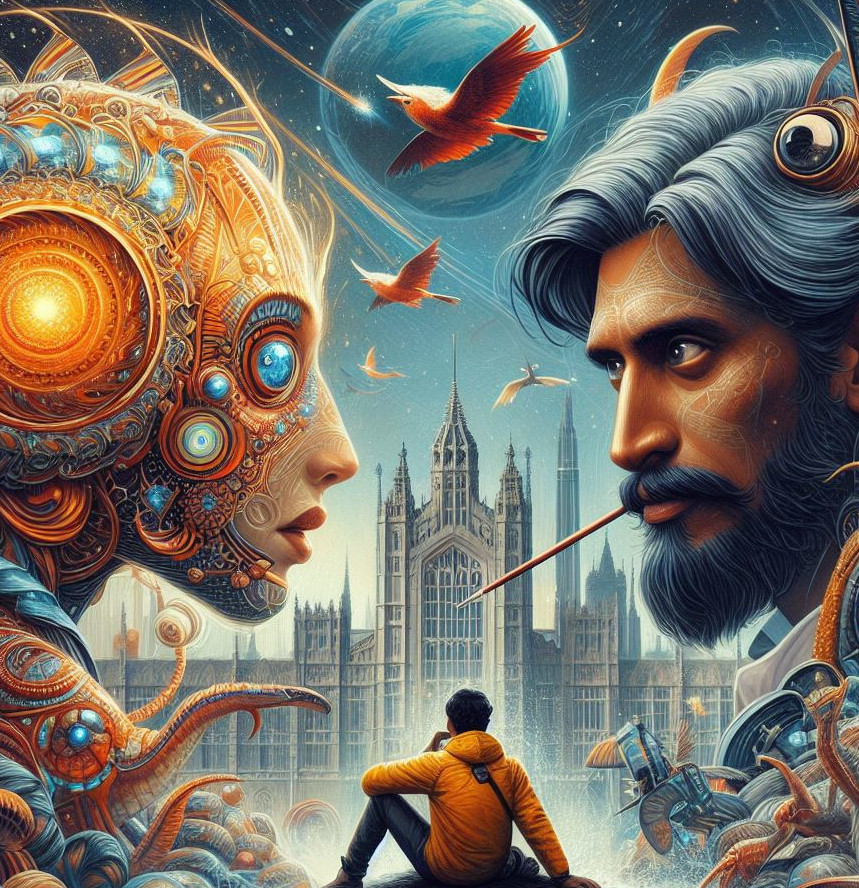
I asked her what she was. How did she know of other intelligent species?
She simply said she was a remnant. Although I got the sense she capitalised the ‘R’, as if it were her name or designation. I wanted to explore this further, but the finality in her voice made me think that was a conversation for another time.
She acknowledged my silence with a nod. “You were the right choice.”
I wasn’t sure whether to feel honoured or trapped. Instead, I stood and paced the room, digesting what I’d been told. Here was an ancient creature, clearly not human, although ably capable of imitating one, in my living room, telling me that slowing our progress was in our best interests, and it was history that informed her that.
“Is there anything else you’d like to know?” she asked.
I asked if she’d ever been wrong. If a door had ever opened onto a room after all, and the drop had turned out to be a floor.
She looked at me for a long time. She said, ‘Not yet.’
I still can’t decide whether that was the most hopeful thing anyone has ever said to me, or the most worrying.
“Why the forms?”
“I need your consent.”
So, that was it, I was Guardian of the Estate of Humanity.
19 November
I thought about refusing to sign at all, but a blank form is only a ‘Yes’ handed to whoever they give it to next, someone who never loved a woman the disease took, someone who’ll tick intervene before lunch and sleep like a child after. My refusal saves no one, it only keeps my own hands clean, and I’ve learned since taking this job that clean hands are cheap, and probably not worth having.
For a few nanoseconds, I thought about going to the papers, and telling the whole story. But then I pictured the editor’s face, and I understood that I wouldn’t be a whistleblower, I’d be a sad old academic who lost his wife and then his mind. Sayer’s people wouldn’t have to lift a finger. The world would discredit me without pausing for breath, the way it discredited that clever woman last year.
So, this job is mine. The whole weight of it comes down to one tired old man and a form, which I begin to think is exactly how it’s always been done, and exactly why they chose someone like me. Someone already half persuaded, who is already grieving and already so practised at mourning the lost roads that he might sign away one more.
I keep reaching for the pen and finding my hand won’t close on it. I decided to leave it until I’d slept on it one more night. The irony of me procrastinating about a matter of such great import was not lost on me. For the first time that day, I smiled.
23 November
It’s due today. The consent form, with its two boxes. One says let it stand, the other says intervene and sponge the paper clean. A line beside them for my name. I wondered if someone, someday, would look at that name and either revere or despise the holder. I was a pretty poor Guardian: a shuffling, retired academic with a fondness for whisky and Cuban cigars.
I’ve thought about signing enough times to know how it’s meant to go. You don’t decide and then sign. You sign, and then you find out what you decided by watching your own hand do it. That’s near enough how the monk did it, I expect. Picked up the sponge, did the job, went to his supper, and left it to history to call him a fool or a saint.
But the hand won’t move on its own this time, and so I’m left actually deciding, which I begin to think is the cruellest thing they’ve done to me. I’ve sat here since dawn with both reasons laid out in front of me like a man choosing a tie for a funeral: black or black.
Twice, I’ve put the nib down on the box marked intervene. Both times it was my clever half doing it, the half that had read the file and followed the argument, and knew that the door had a bottomless pit the other side of it. And both times I’ve lifted it again, because of a feeling inside, the feeling of a man who listened to his dead wife, who said that a little boy will die if I intervene. I pictured his mother sobbing over his grave, the broken shoulders of his father. Then I imagined their joy if I let it pass. I wanted the guilty pleasure of sharing in that joy. I wanted to be one of them, of belonging one last time.
And twice I’ve moved the pen across to let it stand, and lifted it again from there too, because I couldn’t swear the hand was moved by mercy and not just by grief. By the plain animal wish to hand the strangers on the TV a moment of relief, and never mind what it costs them later. I don’t trust my mercy any more than I trust my cleverness now.
On one side there’s the cure: all those houses where the cup gets lifted again, and the spoon, and the word, the word most of all, handed back to people before they face their November. On the other side there’s whatever Sayer swears is waiting behind it. The pit that ends us all, followed by the long quiet afterwards, with no one left to remember things were ever any different, because there’s no one left at all.
And in between there’s me, and a pen, and a page on which I imagined Elin’s grey face just under the surface of it, the way the writing was grey under the prayers for the dead in the palimpsest.
I thought that I could do this without my hand shaking. But I was wrong, my hand is shaking now. I’ve been watching it do it for the better part of an hour, and I’ve stopped trying to make it stop, because somewhere in that hour I worked out what the shake is. My clever half doesn’t shake; it never has. The shake is the part of me that still feels the weight of my decision, that still says ‘we’ when I’ve trained the rest of me to say ‘they’. And I find I would rather hand the choice to the part of me that can still shake than to the part that has gone smooth and certain and quick. That isn’t the same as knowing which box it will choose. Even this part is torn down the middle, her on one side of it and the whole frightened world on the other. It only means that whatever I tick, I’ll have ticked it as a man, and not as an automaton.
So this is where I’ve come to, after all of it. I don’t know which box is the wise one and which is the weak one. I’ve given up expecting to know before I sign. I only know I’d rather sign with the hand that shakes, and let it cost what it costs.
I’m going to put the pen down for a moment. I’m going to sit with the shaking until it tells me, and then I’ll tick one box, and I am not going to write down which. Not even here, even for you, whoever you turn out to be, if anyone ever comes looking.
In the end, my hand made its decision. If you’re still here, it’s either because we didn’t walk through the door, or because there was a floor on the other side. I’m not sure I remember it correctly. I signed, slipped the form into the envelope and left it on the hall stand where it will be collected overnight by a means I have no knowledge of. Tomorrow there will be another form, and I will circle around it, make my observations, and sign again. Dante would have you believe there are only seven circles of hell, but I have learned there are far more. They are unending, but hopefully, so are my brothers and my sisters, the scrabbling, singing throng of the human race, but most of all, I hope I retain the one thing that’s most valuable to me: my humanity.
Dedication
For Doctor Elizabeth Jane Bridger, a former trust grade doctor in emergency medicine at Taunton and Somerset Hospital. Jane died from respiratory failure secondary to anti-Jo-1 syndrome on March 31st, 2001. Never forgotten.
Be First to Comment