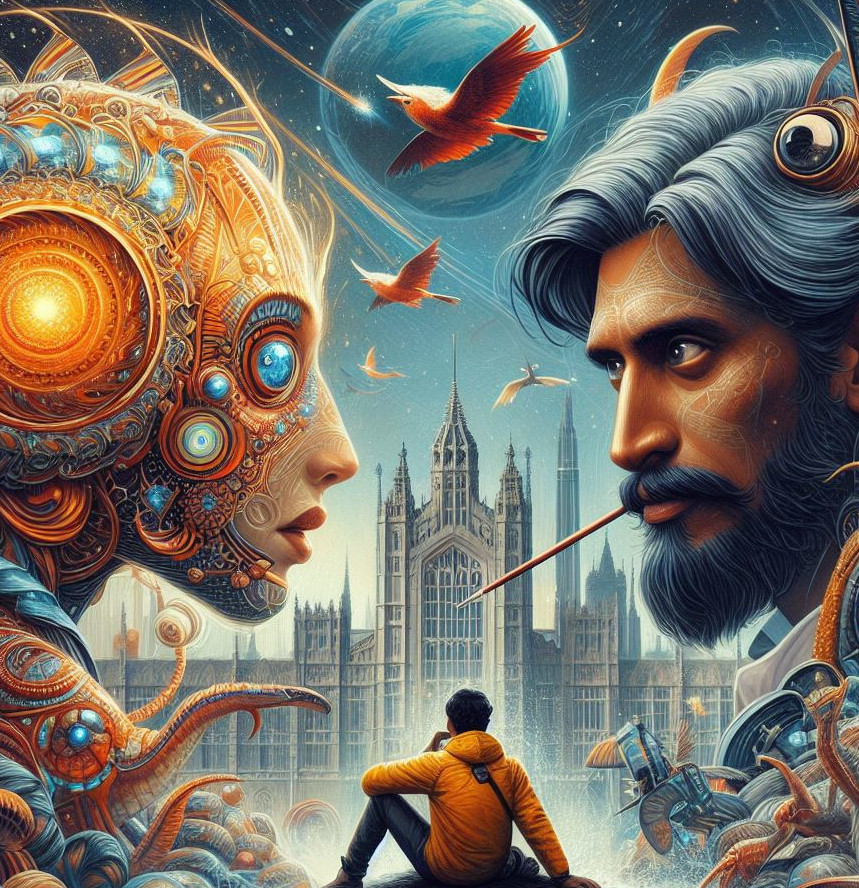
I was born at uhta, that time just before dawn when the mists roll in across the low hills and, some say, the wihts are abroad.
I had refused to be born, so my sweat-soaked mother had to strain harder than she had with any of my siblings, to push me out. Uhta, being neither dark nor light, and my reluctance to join the world, clinging instead to the otherworld, was the reason that, as I finally made an entrance, Mim-mim spied two creatures watching from the edge of the woods, across the sweetgrass meadow: a heorot, standing firm and sound, with eyes of soft brown and a wulf, eyes dark and ravening.
These were my birth omens.
Of course I didn’t know any of this then, I was too busy objecting to the slaps, taking my first lungfuls of air and expelling them on angry wails.
No – all this lore I had told to me by Mim-mim, my grandmother. She said I was twice-claimed, one for good and once for yfel. But she couldn’t say for sure yet which one would gain ascendancy. So, she watched me like the hawk with the field mouse, and any behaviour she deemed odd or noteworthy she traced back to these two animals. When I helped mother with feeding the chickens, picking and washing vegetables, she would nod and say, the goodness of the heorot was working through me. Whenever I fought with my brothers or stole a slice of bread, she would claim it was the spirit of the wulf, rising in me.
‘Stop that, mother,’ my mother would tell Mim-mim, crossing herself, ‘filling the child’s head with un-Christian nonsense.’ Mim-mim would stop then, but she would keep her eyes on mine, so I knew that although she might have been quietened, she meant what she said.
Mim-mim lived in a tiny hut at the edge of our small holding, hidden under the trees. As befitted someone with two birth omens, I lived between two dwellings, one a practical household filled with the everyday tasks of feeding animals, digging vegetables, and pickling for winter; and the other, a small hut, with bed, blankets and a small, blackened stove, lit only in the coldest nights. But it was the stories that transformed this hut. Mim-mim’ s world was not the one mother and father could see, it was the one at the edges of things. It was the creatures in the woods, the movement from the corner of the eye; the thing that made the floorboard creak or the picture fall from the wall. It was full of strange beings, not like our boring chickens that scratched the earth and clucked indignantly when I pulled warm eggs from under their soft bodies.
And it was the world my friend Alice lived in, gentle and shy. I longed to tell Mim-mim of my friend, but her watchful gaze cautioned me against sharing that Alice was taller than any man, naked except for the long hair that covered her, and had tusks. She didn’t talk, but that didn’t matter. I gave her the name, Alice. There were others, but only Alice came near to me. She showed me the best place to find mushrooms, or dry kindling, and when I could, I gave her eggs.
Despite Church in the village every Sunday, Mim-mim cleaved to the old world; the old language rich on her tongue, to the disapproval of the family.
‘Tell me about the nicor again,’ I would beg, and Mim-mim would relate the tales of water dwellers, playful and tricksy, enticing people into their lakes. Or she would tell of the fenix, a hen like bird that set fire to itself if caught, or the naedre the venomous snake-like ones. Of all the tales, the dark creatures who would lure trusting people to their grisly fate were my favourites. But, if I was too eager with my questions, too curious, Mim-mim would tut and say my wulf was tempting me. I was closer to Mim-mim than the rest of my family, and we loved each other, or I thought we did.
In all the tales, Mim-mim never spoke of Alice’s people, but I didn’t notice this omission for a long while. Once I did, it seemed all I could think about.
‘Did you ever see a nicor, with your own eyes, Mim-mim?’ I asked, one evening, as the light faded outside the hut. Mim-mim worked her mouth side to side as she always did when she was thinking.
‘There are many strange things that wander the world,’ she said, an answer I now recognised as typical of Mim-mim; and one that didn’t answer my question.
‘What about the naedre?’
‘They steal the eggs sometimes.’ Another indirect answer; I knew that meant she hadn’t. I swallowed but couldn’t think of a way of asking what I wanted, what I needed to. I had never seen the creatures Mim-mim told of, but Alice was real, I had seen her leave a footprint once, in the mud, before she used a branch to destroy it. They left no mark of their passing.
‘Have you ever seen…any other creatures?’ I looked at her face. She was still, even her mouth, and her eyes glittered strangely in the half light of the hut.
‘Have you?’ she asked, her voice sharp.
Under those liquid black eyes, I told her everything. I told her about Alice and the tusk women, with the large teeth that curled up from their lower jaws and over their upper lips. And how they watched me from the under the trees as I swept the dirt yard, or collected Hanna, our wandering hen.
How they followed me whenever I was in the woods, Alice with me, some further away, quietly keeping pace, occasionally glimpsed.
—
I was sent away, looking back from the cart, refusing to look at my family and Mim-mim, but only toward the woods, hoping Alice would understand. The journey was long, and I had too much time to recall Mim-mim’s face, white and drawn as she muttered ‘Unclean, unclean,’ under her breath and hurriedly flung bags of herbs, sweet and foul around my neck.
I worked on my uncle’s farm and it was years before I returned, and only then when mother, who had never before paid any store by Mim-mim’s tales, had written to make sure I was wearing Mim-mim’s necklace of bone charms, and I had drawn hexafoils on my wrists.
I smiled and curtsied and made myself useful back in the bosom of my family.
But soon, I would leave the necklace behind, wash off the wards, and go to the woods, and Alice.
—
Notes on pronunciation:
Heorot – heh-o-rot
nicor -nick-or
naedre nadd-ruh
Be First to Comment