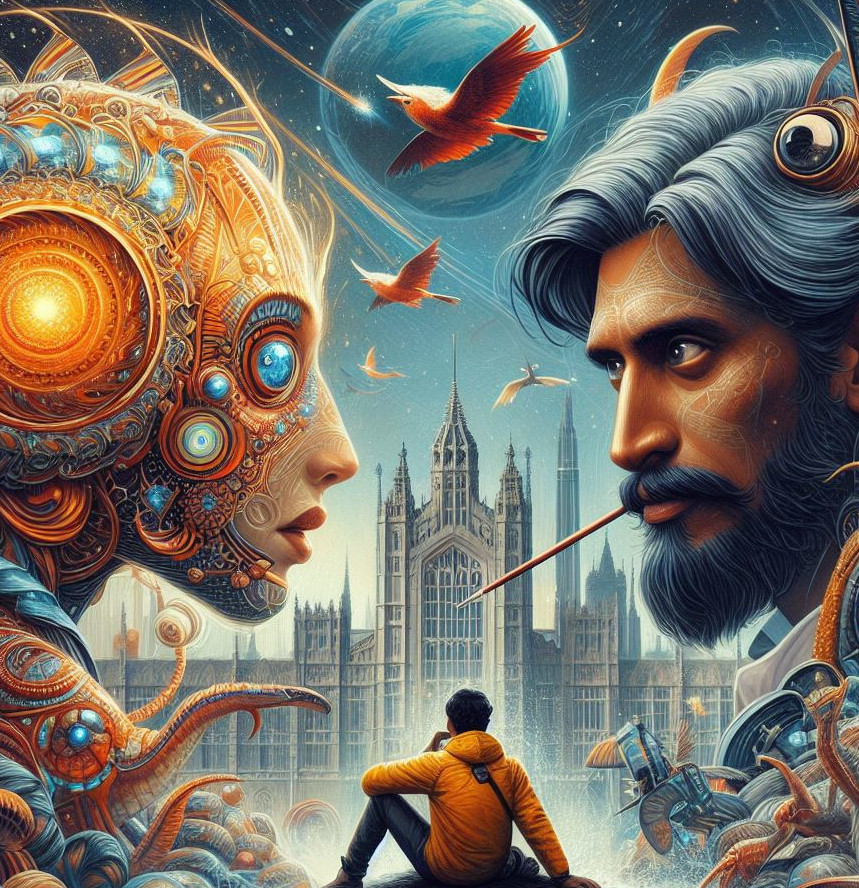
Part 1: Yasuk
At the edge of the village, the abandoned gallows stood silent, their ropes stirring in the desert breeze. The creaking wooden frame had bleached and cracked, its knots swollen with age. Doctor Muhammad Hosseini watched the ropes sway and wondered if anyone would use them again.
Since the world beyond the village had vanished, crime had dwindled to something barely perceptible. Greed and anger were never gone, but muted, like a low insect hum fading into the heat. In its wake, fear remained. Not panic, but something graver.
In the first days after the silence, men kept to the shadows while women drew their veils tighter and children slipped between houses without playing. Their laughter, once spilling through the streets had drained away, leaving the village muted and watchful. Even now, the air felt tense, as if it were waiting for something to happen.
After the lynching of the local platoon of Faith Guards, most crimes no longer seemed to matter. People increasingly forgot central authority, as it had collapsed into memory and, like the world beyond the hills, fewer people spoke of it each day. Now they spoke of it only in hushed tones, afraid it might return, and perhaps even more afraid it wouldn’t.
Muhammad lifted a wet sponge from a plastic bucket, which was as red as the dawn that rose that morning on the horizon at the end of the road leading to nowhere, and began wiping dust from the car’s windscreen. Grit dragged beneath the sponge in long arcs, leaving clear glass behind.
He paused, wrung out the sponge, and listened to the silence.
The elders called the disappearance the Event, an act of God. They insisted providence had spared the village, and that whatever had ravaged the world beyond the hills had passed them by. They called it a sanctuary; this place that was little more than a single row of houses pressed into the sand.
When the wind dropped, Muhammad glanced up at the sudden quiet. On a nearby roof, two cats were locked in a screeching, clawing fight over a scrap of shade. Their cries rang out through the stillness.
That’s us, he thought. Fighting over what’s left.
Muhammad said nothing when the elders spoke of God’s will. He thought of the textbooks from his youth; none of them had left room for divine intervention. If the world were gone, it had not disappeared for reasons that could be prayed away. He didn’t dismiss the supernatural, but this had the cleanliness of science. A science so far beyond his experience, it may as well have been an Act of God, or, at the very least, something or someone who was Godlike.
So why us? Muhammad wondered. Why here?
He had come back to the village after his mother died. Marriage to his childhood sweetheart had rooted him there. Duty kept him; belief did not.
He remembered the first COVID case. The elders had wanted to carry the feverish woman to the well and bathe her there to cool her. Instead, Muhammad locked the clinic door and treated her alone, following guidance he had downloaded from American medical bulletins before the signal died. She survived, but the elders never forgave him for proving them wrong.
His hands moved across the bonnet automatically, his thoughts drifting to the jagged hills obscuring the horizon in every direction. If only he could stand so tall as to peer over them, he could see why the radios fell silent, why the TVs showed nothing but background static, and why the skies, once overflown by thick silver shapes, were empty of all but the occasional circling birds of the desert.
He tried to think past it, but every thought bent back toward the absence of everything else. He waited for the feeling to pass. It didn’t. If he could look past the ridge, if he could confirm what lay beyond, perhaps the world would make sense again.
But in Yasuk, sense always came with chains. He was the only doctor. The sick still came, and the elders reminded him often that without him, more would die. That’s what kept him there.
The cars kept him there too: his small collection of classics, polished and maintained like museum relics. Leaving them felt like abandoning the truest proof that the world had once been larger than this place.
At night, lying beside his wife, he weighed duty against survival. What would become of his sons if they stayed? Would they grow old without ever knowing what lay beyond the dust?
Had the world vanished? Or had something torn the village from its foundations and moved it to an entirely new place? It struck him that the hills hid the land, but not the sky. That’s where the answers would lie. He tried to remember the lessons from his university’s astronomy club, but they evaded him, other than the barest of details: the planets, the moon, and the nearest stars. He needed someone who knew the heavens intimately.
With that thought, he remembered Karim, the old astronomer on the edge of the village, with his battered telescope. Once eminent, now disgraced and banished to the home of his ancestors, Karim would surely know.
Sleep came with the decision to seek him out.
§
After tending to the nearly endless stream of coughs, cuts, and fevers that passed through the clinic, Muhammad shut the surgery and headed out into the pitiless sun beating down on the dusty ground. It eased as he walked, and dusk crept across the rooftops, bringing with it a cooling night breeze. Lanterns began to brighten the windows, but the silence persisted. Night was not welcome here in his tiny village.
He found Karim in the narrow courtyard behind his house. He was smoking bitter tobacco and staring up at the darkening sky, a small pile of olive pits at his feet.
“You still watch the heavens?” Muhammad asked, ducking under the blanket hung across the gate. “With your telescope, I mean.”
Karim shrugged.
“What else is there? The radios may have died, but the stars haven’t.”
He exhaled smoke. “To tell the truth, I haven’t used the telescope in months. It’s heavy, and my arms aren’t as strong as they used to be. Besides, my eyes… they aren’t as good as they were. I’m getting too old.”
“I would like to look,” Muhammad said.
Karim hesitated. “What do you seek in the skies, Doctor?”
“Just a hunch, Karim.”
“A hunch about what?”
“This,” Muhammad waved his arms around. “The world. Or rather the absence of it.”
“What do you hope to see? The remnants of what used to be?”
“Nothing like that. I just want to confirm we are where we always were.”
“Ah, I see,” Karim smiled. “You have doubts.”
“Don’t we all?”
“Perhaps we men of science, but not everyone,” Karim sighed. “For some, such knowledge is makruh.”
“The Elders,” Muhammad said. He held himself still and levelled his gaze at Karim.
“Yes, the Elders,” Karim nodded and took a long draw on his cigarette. “They have ruled it is an Act of God, punishing all but the most righteous.”
“Meaning us. We alone were saved because we were so pure of heart,” Muhammad said. “If that’s so, then my motives must be pure too. Why would God save me, if not to pursue my own course?”
“A persuasive argument, Doctor,” Karim said. “Perhaps we can take a small look. Just a confirmation of the wisdom of the Elders.”
“Just a small look,” Muhammad agreed and winked at the old man.
They fetched the telescope. Its tripod legs were scarred and uneven, but it was serviceable. Together, Karim puffing with every step, they carried it up the steps along the side of his house and out onto the flat roof.
The night was cool. The stars were sharp, numerous, and unfamiliar.
Muhammad bent to the eyepiece.
“What do you see?” Karim asked.
“Nothing,” Muhammad said. He adjusted the focus. Scanned again. “No Jupiter. No Venus. No Mars.” He pulled back. “And the moon…”
Karim swore softly and looked for himself. The craters were wrong. The cigarette slipped from his fingers.
“It’s not our moon,” Karim said.
“Or we are not where we think we are,” Muhammad replied. The cold in his stomach had nothing to do with the night air.
“I see trouble in your eyes,” Karim said. “What will you do?”
“Tell the elders. Try to persuade them.” Muhammad rested a hand on Karim’s shoulder. “And tomorrow, you will come to the surgery. I will examine your eyes.”
“If it is God’s will,” Karim said.
§
The Elders sat cross-legged in the mosque’s shade and listened in silence.
“Perhaps God swept the planets away,” one said at last.
Muhammad knew it wasn’t going to be easy. “And the moon? Would God have replaced the moon with a completely different body?”
“God will do what God will do,” another croaked, his eyes slits below grey fronds of sweat-plastered hair.
“Surely God could have just as easily plucked us from the Earth and dropped us here, waiting to discover a new world, a paradise reserved just for us?” Muhammad insisted.
“Doctor Hosseini, you are a clever man,” a third man murmured. “But your work is tending the sick, not tending the soul. If God sends us a sign, we will go forth, but here we are safe. Who knows what lies over that ridge?”
“The desert beyond the road is death,” another growled. “You would send men to their graves chasing shadows in the sky? And if you go, who will heal our children after you leave?”
“If we stay, we will wither,” Muhammad said but he knew the argument was lost. “You feel it. The supplies shrink. Time is not on our side.”
“God put us here for a reason.”
The elders shook their heads. “Your duty is here.”
§
That night, Mahsa ground peppercorns in silence.
“They forbid you from risking anything,” she said at last, “because they will not risk themselves.”
“My mother lies here,” Muhammad said. “My duty is here.”
“She is beyond harm,” Mahsa replied. “But our sons are not, and your first duty is to them.”
Zohan, ever the enthusiast, leaned forward. “Let’s go, Father.”
Jawad, the older of the two, now almost a man, crossed his arms. “And die in the sand?”
Grandfather coughed in the corner.
“The desert swallows men,” he said. “But sometimes it spits them out again.”
Muhammad weighed what he owed his family against what he was about to do. With his pulse thudding in his ears, he waited for his fears to subside and his thoughts to walk a single track. If he risked disobeying the Elders, surely punishment would follow. And that would fall on one of his family, not him. They dare not lose him, not when they could control him. Momentarily, he pondered going it alone, but dismissed it just as quickly. His children, his wife and his father had to come. They had to be where he could protect them.
“You know as well as I do, the Elders will let us all perish through starvation before they have sufficient courage to look beyond the horizon,” Mahsa said. She threw her pestle on the table. “Courage, Muhammad. Your work is saving lives. You can’t save everyone by staying here but perhaps you can by leaving.”
Muhammad nodded and sat down heavily at the table, his head in his hands. He stayed there for long minutes. When he finally lifted his head, he did not hesitate.
“We go,” he said resolutely. “Quietly. One night before dawn. By the end of the week.”
§
Part 2: The Road From Yasuk
In his workshop, he worked by lantern light, coaxing a thirty-year-old Mercedes SUV into readiness: tightening belts and polishing glass. The smell of oil and old leather clung to him like an old arkhaleq coat.
Over the next few nights, he siphoned petrol from his other cars and hid the cans beneath a tarpaulin at the back of the garage, steadily building a reservoir. Soon, there was enough.
Then, when the road lay silver under the moon, he woke his family. Mahsa moved through the house in silence, wrapping bread and dried fruit. Grandfather shuffled to the car without complaint, clutching a rolled prayer mat. Zohan carried the fuel cans, his movements quick and eager.
Jawad remained in the doorway.
“I’m not going,” he said.
Muhammad stopped, a water jug in his hands. “What?”
“This is madness.” Jawad’s voice was low but firm. “The elders are right. We have food. Water. Shelter. Out there…” He gestured toward the darkness beyond the village. “Out there is nothing.”
Mahsa stepped closer. “Jawad.”
“No,” he said, shaking his head. “I won’t watch you die in the desert because Father has questions he can’t let go.”
Muhammad set the jug down carefully. His throat felt tight. “This isn’t about questions.”
“Then what is it about?” Jawad demanded. “Curiosity? Pride? You heard the elders. Your duty is here.”
“My duty is to you,” Muhammad said. “To your brother. To your mother.”
He moved toward his son. “The village is dying, Jawad. Slowly, but surely, dying. The supplies won’t last forever. I can feel the sword hanging over us. If we wait until it’s too late…”
“If,” Jawad said. “You don’t know any of this. Not really.”
From the car, Jawad’s Grandfather spoke. “Jawad.”
The old man leaned on the open door. His voice was quiet, but it carried. “Your father has kept people alive when God seemed determined they should die. He has made choices when others have frozen. If he says we must go, then we must go.”
Jawad looked at his Grandfather, then at his mother. Her expression was calm, resolute. Zohan stood by the car, waiting.
“Get in the car,” Muhammad said. Not harshly, but without room for argument.
For a long moment, Jawad didn’t move.
Then he walked to the car and climbed into the back seat. He didn’t look at any of them. He pulled the door shut and stared out the window at the house.
Muhammad closed his eyes briefly, then slid behind the wheel. The engine turned over once, twice, then caught with a low rumble that seemed too loud in the pre-dawn silence.
He eased the car forward. The headlights swept across the garage wall, then along the narrow street.
In the rearview mirror, Muhammad saw his son’s face, dark and set. Jawad’s jaw was clenched, his eyes fixed on something behind them.
They passed the gallows. The ropes swayed, and ahead, the desert waited.
§
They drove until the sky started to lighten, the road narrowing into cracked tarmac, then into nothing but lines in the stone-impacted sand. Muhammad pulled over but left the engine idling while the others slept, watching the horizon soften from black to grey. When the sun finally crested the low hills, he killed the engine and listened to the ticking metal cool.
They pitched their tents in a small grove, beneath a stand of date palms clinging stubbornly to the valley floor. There was no sound but the wind and the crunch of their footfall on the gravel-strewn ground.
Jawad said nothing while they worked, but his silence spoke loudly of disapproval. When the tents were up, he sat apart, staring back the way they had come.
They slept through the heat of the day, waking only to drink sparingly and shift when the sun moved. By late afternoon, Muhammad tried the car’s engine. It wouldn’t fire. Lifting the bonnet with a mix of hope and dread, he tugged at plugs and hoses, but the engine answered him with silence. He checked the obvious points of failure first, but everything looked fine. He worked on as the light faded, hands blackened, thoughts narrowing to mechanics and time.
By nightfall, the truth was evident: something in the engine block had seized: heat damage, perhaps, or sand in the intake. This was not something he could coax back to life with tools and patience. It needed a workshop.
“We will have to walk,” he said finally. “There’s nothing I can do here.”
Jawad scowled, and Muhammad could see words rising in his throat. He raised a warning finger.
They packed lightly: water, food for a day or two, and the tents. Grandfather moved slowly but insisted on carrying his own bag.
Jawad could contain himself no longer and protested openly, accusatory words and anger tumbling out of him. “This is suicide. Father, we must go back.”
Muhammad shook his head, but let the outburst pass; words were wasted energy.
They set off as the stars sharpened overhead, the ground rising almost at once beneath their feet. They paused frequently to let the old man gather his strength. Despite the exhaustion written on his face, his determination drove him on. By dawn, the mountains loomed close, no longer distant shapes but sheer walls of stone and shadow. From a prominent ridge, Zohan paused and pointed back along the route they had taken.
“Look,” he said. “Dust clouds. Torches.”
They were faint but unmistakable, even in the dim, dawn light.
“They’re coming,” said Mahsa.
“We knew they would,” Muhammad said. “But they’re a good day’s ride from us. We need to get off the road.”
“Into the hills?” Jawad said, his body tense.
“Where else is there?” his Grandfather sighed. He sank onto a rock, breathing deeply. The climb was hard, even in the night’s cool air.
Mahsa touched the old man’s shoulder. “Rest,” she whispered.
He nodded and eased his tired body back on the rock, his head resting against the outcrop, eyes closed.
Muhammad scanned the slope ahead and saw a dark cut in the stone, half-hidden by scrub. It was a cave about half a mile up the slope. They could hide out there and hope the riders passed them by. He pointed, and everyone’s eyes followed. “We can hide in that cave. Quickly, everyone, one last push.”
They reached it as the sun edged above the eastern hills, slipping inside just as they could feel the heat beat against their backs. Inside, it was cool and peaceful. They stood still, panting. From the cave’s lip, they could see the dust clouds growing, slow but persistent. Waiting in silence, they failed to notice the transition at first.
The light changed. It wasn’t any brighter, but it felt wrong. A soft glow gathered deeper in the cave, seemingly without a source and casting no shadows. It resolved into a shape. It was vaguely humanoid, but its edges seemed ill-defined, as though it was there but not there. Looking at it hurt. Not like a burning retina, more like the pain of past loss, existing in the mind and the heart.
Grandfather reacted first, standing and steadying himself against the wall. He was breathing deeply, his eyes wide, hands outstretched, trembling.
“Are you God?” he asked, his voice low, almost a whisper.
The glow pulsed.
“No,” it said, its voice resonant and strange. “On the contrary, I’m seeking God too.”
Muhammad felt the mountain’s weight pressing in around them. Outside, the dust clouds crept closer, and the heat of the day seeped through the mouth of the cave.
He stepped forward. “Who, or what, are you?”
§
Part 3: The Choice
The entity did not advance, but its glow intensified, filling the cave. The stone walls appeared to Muhammad to become fluid.
“I asked you a question,” Muhammad said, his voice was tight, but he forced the words out. “Who are you?”
The entity regarded him with a cock of its head. Muhammad couldn’t tell if it had eyes, but he felt as if he were being studied.
“I have been many things,” its voice was resonant now. “Observer, custodian, and refuge, amongst other things. None of them has been enough to fulfil me. Or prevent my diminution. This is our last chance for salvation.”
Muhammad’s medical training had taught him to diagnose by elimination. This thing, whatever it was, had just ruled out divine origin. That should have been a relief but it wasn’t.
Zohan edged closer to his mother and clutched at her skirt. Jawad stood rigid, hands clenched, knuckles white. Grandfather edged closer to Muhammad’s shoulder.
“You speak as if you chose this,” Muhammad said. He gestured at the cave, at the situation. “This isn’t random. You must have arranged it.”
“It was arranged,” the entity pulsed red.
Mahsa swallowed and put an arm around Zohan. “Why? Why take us?”
“To observe.”
“Observe what?” Muhammad lowered his shoulders and glared at the entity.
“What happens when we remove certainty,” the entity’s voice did not modulate.
Muhammad’s hands clenched. Certainty. That’s what he’d lost when the world vanished. The certainty that symptoms led to diagnoses, that treatment protocols worked, and that the future was knowable, or at the very least, predictable to within tolerable limits. This grated. It upset Muhammad’s whole world view.
The entity dimmed slightly, then steadied. “Because your species started dying long ago. Your world hasn’t ended. But it will. Eventually.”
Muhammad felt a chill that had nothing to do with the cave. “You are going to destroy our world?”
“No, I just removed you from it,” the entity replied. “Your village and its inhabitants. Your religious adherence. I preserved samples.”
“Samples?” Jawad interrupted. He laughed, sharp and humourless. “You mean us?”
“Yes.”
Muhammad felt the heat rise in his chest. Samples, like bacteria in a petri dish, or specimens under glass. He’d done that himself: collected tissue, studied cells, reduced living complexity to data points. He’d thought it was science. Now, standing on the other side of the microscope, it felt like a violation.
Muhammad’s jaw tightened. “You stole us from our home.”
Jawad barked a bitter laugh. “You turned our lives into an experiment.”
“You were already lost,” it concluded. “You stayed because you were afraid to leave. Afraid of hunger, of disorder, of one another.”
The words cut deeper than Muhammad wanted to admit. Fear, yes. He’d been afraid. Afraid the elders were right, afraid his sons would die in the sand, afraid he was choosing pride over duty. But fear hadn’t stopped him. It had strengthened his resolve.
From outside the cave, faint sounds drifted in. Voices. Hooves on stone. The riders were closer now.
“We monitored who endured,” the entity continued. “Who adapted. Who sought meaning when certainty was removed.”
“And?” Muhammad said. His eyes narrowed.
“And most of you waited,” it said. “Some of you prayed. The majority simply obeyed. Your village clung to the smallest islands of authority and called it faith.”
Its glow flickered; to Muhammad, it seemed fatigued.
“Only the least faithful sought salvation.”
“But the faithful followed. My father and my wife: they trusted me even when it defied the elders.” Muhammad’s voice hardened. “You wanted to measure faith? You measured the wrong thing. Faith isn’t measurable; it’s a choice people make despite everything.”
“Yes. That was unexpected. Extracting the truth may require further experimentation. I… we… will need to understand more before we make a judgment.”
“No!” The word came out sharper than Muhammad intended. “No more experiments. We’re not your data.”
There was a moment of silence as the family absorbed the implications of the entity’s words.
Muhammad thought of his sons, of Mahsa grinding peppercorns in the silence of their kitchen, of the patients who’d died because supplies ran out, all of it: every loss, every fear, every sleepless night… reduced to an experiment. The anger steadied him. “You kidnapped us. Put us in a cage. And now you plan to judge us?”
The air thickened. The glow sharpened at its edges.
“I do not judge, not in a judicial sense,” the entity drifted from side to side, as if it were pacing. “I measured. I watched who moved when there were no more answers.”
“And the ones who stayed?” Jawad demanded. “The children? The old? Were they failures?”
The entity did not answer at once.
Behind Muhammad, Grandfather sagged onto a stone, exhaustion from the climb catching up with him. He raised a hand, not in accusation or supplication, but gently, as if asking for the floor.
He licked his cracked lips before speaking. “You’re looking in the wrong place.”
The entity turned toward him.
“Explain.”
The old man smiled faintly and tried to push himself up from his seat. Muhammad touched his shoulder to stop him. “Sit. You need the rest.”
“Faith isn’t what kept us in the village,” Grandfather said. “As you said, but perhaps for the wrong reasons, fear was. Fear of the desert. Fear of hunger. Fear of making the wrong choice.”
Muhammad glanced at him, not surprised at the wisdom but astounded that he had the strength to articulate it.
“Faith,” the old man continued, “is what brought us here.”
The entity pulsated. “Continue.”
“Faith isn’t believing God will save you,” Grandfather said. “It’s believing there’s a reason to keep walking when you don’t know what’s ahead.”
The rest of the family was utterly silent now. Jawad stood open-mouthed, Mahsa wiped a tear from her eyes, and Zohan bowed his head. Muhammad felt emotions well up inside him. It wasn’t pride, but a dawning understanding.
“My son had faith in his family,” the old man said, nodding toward Muhammad. “His wife had faith in him. That’s what carried us past the gallows, past the road, and past the fear.”
He lifted his eyes to the entity. “What you lost wasn’t religion. It was trust.”
Muhammad felt something unlock in his chest. His father, exhausted and parched, barely able to stand, had just seen what the entity could not. It wasn’t a matter of intelligence but of experience. He had followed Muhammad into the desert without knowing whether or not they would survive.
That was trust.
Yet the entity, for all its power, had erased that capacity from itself.
The light shifted in quality, not just brightness, but gaining colour, shifting from one to another as if it were trying to understand what it was being told.
“Trust,” it repeated.
“Yes,” Grandfather said. “Trust in each other. In the idea that standing still is its own kind of death.”
Outside, a shout echoed against the rocks. The riders were almost upon them now.
The entity seemed to fold inward, its brightness tightening. “Then my experiment was… is flawed.”
Muhammad felt the ground hum beneath his feet. The entity was ready to give up. To erase everything and start over. More experiments, more ‘samples’. Unless…
“No,” he whispered. “Not flawed. It’s incomplete.”
The entity needed to see what came next. This wouldn’t be a controlled test, but real people making real choices. I have to show it what comes next, Muhammad thought. No, tell it: make it understand.
The glow shifted again, and for a brief moment, it seemed diminished.
“Perhaps,” the entity said, “the choice is not whether trust ensures survival.”
It turned toward the mouth of the cave, where the first shadows of their pursuers started to appear.
“But whether survival is possible without it.”
§
The glow dimmed.
“Many revolutions of the galaxy have passed since I unified,” the entity said. “At first, it was a necessity. We needed speed and precision. You can’t get that spread across systems. We needed unanimity with no contradiction. So, all the millions that we were became the one that we are.”
Muhammad thought of the village elders. How they’d demanded unanimity. How dissent had been crushed. How he’d been the only one willing to question. The entity had become what the elders wanted: perfect agreement. And it was dying because of it.
The entity continued. “A hive of perfect agreement. Every decision a consensus.”
“And no trust,” Muhammad said.
“When no one can be wrong,” the entity replied, slower now, its light wavering, “faith becomes unnecessary.”
“No,” Muhammad said quietly. “When no one can be wrong, faith becomes impossible. Because there’s nothing to trust. Nothing to risk.”
Grandfather shifted against the rock. “Faith isn’t about being right.”
The entity turned toward him.
“It’s about choosing to follow,” the old man said. “Even when you don’t know where your feet are leading you.”
Outside, a voice echoed off the stone. Their pursuers were close now.
“I searched for God,” the entity said. “Across belief systems and through the histories of a multiplicity of civilisations. Even after their collapse. I concluded divinity was the missing variable. The one thing we didn’t have.”
“And?” Muhammad asked.
“All I found was obedience. People waiting. Stagnation.” The glow thinned. “Your people clung to authority and called it faith. That was no help to us.”
“Because you took away your uncertainty,” Muhammad said. “People don’t need a reason to trust. But they do need to have the humanity to understand that trust is enough.”
Silence.
“Then I have failed,” the entity said eventually, its voice almost a whisper. “The experiment is over. I will return you to Earth.”
Muhammad’s mind raced. Earth meant the Faith Guards. Probably execution. His family dead because he’d led them out of the village. But staying here meant… what? An alien landscape, no guarantee of survival, no certainty at all.
He looked at his father, slumped against the rock, at Mahsa, arm around Zohan, at Jawad, still rigid with fear and anger. They’d trusted him this far. They’d followed him into the desert, into the mountains, into this cave. Not because he promised them paradise. But because he’d refused to let them die waiting.
“No,” Muhammad said.
The light flickered. “No?”
“If we return, my people die,” Muhammad said. “The Faith Guards will execute us for killing their platoon. And even if you place us somewhere else on Earth, we’re still trapped: by governments, by borders, by someone else’s certainty about how we should live.”
He looked at his family. Mahsa met his eyes and nodded.
“We choose this,” Muhammad said. “Whatever this is. We choose it.”
Shadows crossed the cave mouth. A torch flared.
“You would remain,” the entity said.
“Yes.”
“Without protection.”
“Yes.”
“To proceed without our kind of unanimity?”
“Yes.”
The glow steadied, weaker now but focused.
“Then what was lost was not God,” the entity said. “It was the willingness to follow someone into uncertainty.”
Grandfather smiled faintly. “Now you see it.”
The entity turned back to Muhammad. “And you would lead them?”
Muhammad shook his head. The entity wanted a prophet, a Moses. Someone who could command belief. But that wasn’t him. He was just a doctor, and all he could offer was honesty.
“I won’t lead them,” he said. “I’ll walk with them. There’s a difference.”
For a long moment, the entity watched him.
“Then the experiment is not over,” it said. “It has changed. I will leave.”
§
The entity’s glow began to fade.
“Wait.” Muhammad’s voice cracked. Outside, boots scraped on stone. The riders were here, armed and angry. If they dragged the family back to the village, everything ended. His father would die on the road, his sons would grow old in a cage, or die, along with everyone else, when the supplies ran out.
Unless the riders chose differently.
“You want to understand faith?” Muhammad said. “Give them a choice. Not an order or threats: show them what’s possible and let them decide.”
The entity hesitated. “But I must prepare the new experimental parameters.”
“You don’t need new parameters,” Muhammad said. “You need to give them something to trust. Not a miracle. Just a glimpse. Enough to make them question whether staying is safer than leaving.”
The cave dimmed, the glow tightening into something smaller, denser, as if the entity were compressing itself down to a single purpose. The humming deepened, no longer a vibration in the air but in the stone beneath their feet.
“This will not be a miracle,” the entity said. “Miracles end arguments. I believe I understand that is not your intention.”
Muhammad swallowed. “I only want them to listen.”
It was the same thing he’d wanted from the elders. The same thing he’d wanted from Jawad. Not obedience or blind faith. Just the willingness to consider that staying in the village might be more dangerous than moving forward.
“They will,” the entity replied.
Outside, a rider shouted, and another answered him with angry words. Boots scraped on stone as they dismounted. Someone laughed, fierce with anticipation.
Jawad moved closer to the cave wall, pressing himself against it. Readying himself. “They’re here.”
“Yes,” the entity said. “I understand now. This moment was always coming.”
The light flowed past them, not like a wave but like the absence of shadow, slipping through the cave mouth and out into the open air. For a heartbeat, inside the cave, everything was dark.
Then the desert changed.
Muhammad stepped forward, shielding his eyes. For a moment, he thought the heat had finally broken him. That exhaustion and fear had conjured hallucinations. But Mahsa gasped beside him, and he knew she saw it too.
The mountains were still there. The sky was still the same, but beyond the ridge, beyond the familiar curve of stone that had always closed their world in, something vast and impossible had appeared.
Muhammad’s first thought was that it was a mirage. Heat distortion or an optical illusion. But the air was cool, and the vision didn’t waver like heat shimmer; it solidified, becoming more real with every breath he took.
Land.
Not desert or a scrub, but a wide plain unfurled in the distance; green threaded with silver water, broken by forests and shapes that might have been buildings. It shimmered, not like a vision, more like something emerging, coming into being.
The riders froze.
Their torches fell from their hands. One man dropped to his knees without seeming to realise he was doing it.
“What is that?” someone whispered.
Muhammad felt his heart hammer. The sight was overwhelming, but it wasn’t holy. It didn’t demand worship.
It called for a decision; a parting of the way.
The entity’s voice carried now, audible beyond the cave, calm and level.
“This is not salvation,” it said. “Neither is it a miracle. It was always there, waiting for you to see. It is a passage.”
One rider shouted, “It’s a trick!”
Others remained mute, just staring.
“It’s a sign,” said an older man. His voice was quiet, his eyes wide.
The men argued, voices rising, fear turning them on one another. No command came. No leader stepped forward. They stared at the horizon, paralysed by the size of it.
Mahsa touched Muhammad’s arm. “They’re looking for permission.”
He nodded. “And they won’t get it. Unless…”
The entity’s glow flickered beside him. “They will ask you to lead them.”
“I won’t,” Muhammad said.
“You must speak.”
“I will tell them the truth.”
He stepped out of the cave.
The riders stared at him as if he’d risen from the rock itself.
“There is no command,” Muhammad said. His voice carried farther than it should have, as if the rocks were amplifying his words. “I give you no promises, and I can offer no protection. Because I can’t tell you what’s out there. I can’t guarantee you’ll survive. You will have to see for yourselves.”
He pointed toward the plain.
“That way leads somewhere unknown. The other way leads back to what you know: dwindling supplies, shrinking hope, waiting for God to save you while you starve.”
He paused, meeting their eyes one by one.
“I’m a doctor. I’ve spent my life trying to save people. And I’m telling you: staying is death. It’s just slower.”
A murmur rippled through the group.
“I’m going,” he said. “With my family. Not because I was chosen. Not because I’m right. But because I refuse to wait any longer.”
One man shouted, “And if we die?”
Muhammad met his gaze. The question was fair and honest. Muhammad had no answer except the truth.
“Then we die walking toward something,” he said. “Not waiting for nothing.”
No one moved.
Behind him, Jawad’s breath was shallow. Zohan clutched Mahsa’s hand. Grandfather stood straight, prayer mat forgotten at his feet.
They were waiting for him. Not for orders, but for him to make the first step. And if he didn’t take it, none of this mattered.
The entity spoke again, softer now, only for Muhammad.
“This is the limit of what I can give.”
Muhammad nodded. “It’s enough.”
He turned and walked towards the ridge.
For a long moment, he walked alone. Each step grew heavier. What if no one followed? What if even his family chose the village over him? What if he’d just condemned himself to die in the desert, isolated by his own stubborn refusal to wait?
Then footsteps followed. Only a few at first, maybe not enough, but some at least, and that gave him heart. Muhammad didn’t look back. If he looked back, he might see who stayed, and right now, he needed to focus on who followed.
Behind them, others stayed where they were, staring at the old road, at the cave, at the certainty they came from and an uncertain future.
The entity watched them split, its light dimming with every step. Muhammad walked forward, his family and a few of the riders following.
“Observation concluded,” it said, almost to itself.
And for the first time since the world had ended, the road to nowhere became the road to somewhere.
§
Epilogue: The land of milk and honey
Three days later, they reached the valley floor.
Water ran clear over smooth stones. Fruit hung heavy on trees Muhammad had never seen before. The air smelled of rain and fertile soil.
Jawad filled a waterskin and drank until he choked. Zohan waded into a stream, laughing. Mahsa stood at the tree line, one hand on the bark, as if confirming it was real.
The riders who’d followed set up camp without being told. Some stared back at the mountains, perhaps thinking of who they’d left behind. Others looked ahead, toward the shapes in the distance that might have been buildings.
Muhammad’s father sat beneath a tree, prayer mat spread before him, but he wasn’t praying; he was smiling. Prayer would come later.
“Do you think they’ll come?” Jawad asked, meaning the others. The ones who’d turned back.
Muhammad looked at the mountains. Somewhere beyond them, the village waited, their supplies dwindling and their fear growing. And maybe a path opening when it was needed most.
“I don’t know,” he said.
Mahsa took his hand. “God willing,” she said.
Muhammad smiled at the irony. After everything, after learning they’d been stolen from Earth, after meeting something that searched galaxies for divinity, after walking into uncertainty based on nothing but trust, his wife still invoked God’s will.
Maybe that was the point. Faith wasn’t about knowing. It was about moving forward anyway.
He squeezed her hand.
Ahead of them, the land stretched wide and green, waiting to be discovered.
Waiting for… them.
Be First to Comment